

Expert Advice
Hair In Sunshine
Hair in Sunshine PART 1
Sun, Receding Hairlines and Hair Follicles – Why Summer Is Not Always Your Hair’s Best Friend
Summer. Sunshine. Holidays. BBQs. A little peace and that beautiful belief that “a bit of sun is always good for you.”
Well… almost.
Because your hair follicles may have a very different opinion.
Most people remember SPF for the face, sometimes even for the neck and chest—but the scalp? We usually remember it only when the parting looks like a freshly boiled lobster and the top of the head burns every time we touch it.
Especially men with receding hairlines, thinning on the crown, or the classic “I’m not going bald, I just have a mature hairline” should keep reading very carefully.
Because unfortunately—sunlight does not negotiate.
Your Scalp Ages Too. And It Can Get Very Upset
The scalp is not just “the place where hair grows.” It is a very active biological environment—with hair follicles, microcirculation, sebaceous glands, the scalp microbiome, and a whole army of cells responsible for healthy hair growth.
And this environment does not handle excessive UV exposure very well.
UV radiation and high-energy visible light (HEV, also known as blue light) can trigger oxidative stress, damage follicle cells, and disturb the natural hair growth cycle. Studies show that the scalp is especially vulnerable to this process even before the hair shaft appears above the surface.
So before you even notice a problem—your follicle already knows things are going badly.
Oxidative Stress – When the Follicle Takes the Hit
Sounds scientific? Because it is.
Oxidative stress happens when the body produces more free radicals (ROS) than it can neutralize. And the sun is very happy to help produce them.
The result?
Hair papilla cells start working less efficiently, keratinocytes regenerate more slowly, micro-damage appears, and inflammation begins.
This can shorten the anagen phase—the active growth stage of the hair—and push the hair faster into the telogen phase—the shedding stage.
In simpler words:
Your hair is not falling out to be dramatic.
It is simply trying to survive.
And a follicle in survival mode is not planning beautiful volume for autumn.
Quite the opposite.
Hair In Sunshine PART 2
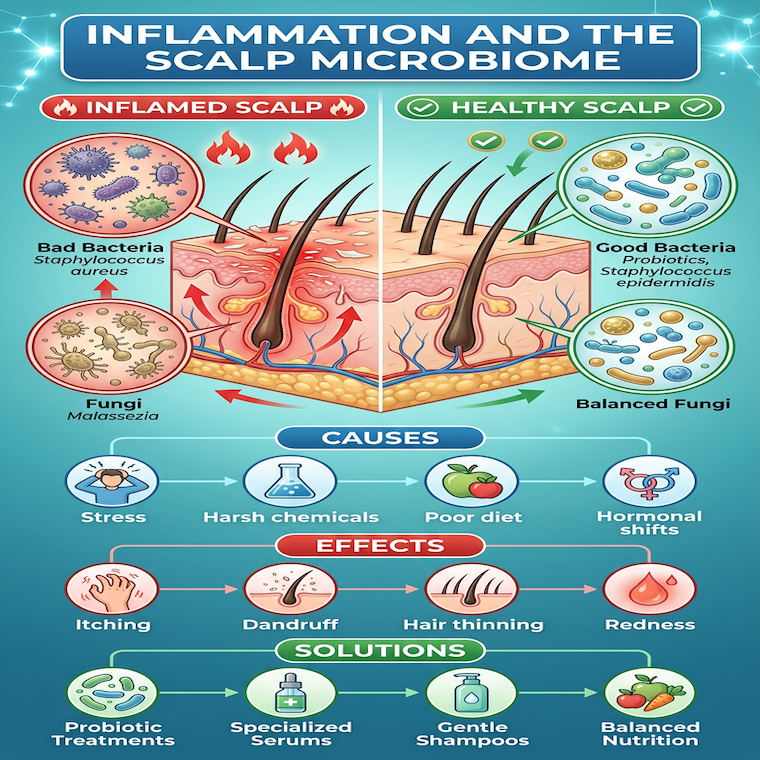
Inflammation and the Scalp Microbiome – When Summer Starts Working Against Your Hair
Now that we know the sun can exhaust your hair follicles more effectively than a Monday after a long weekend, it is time to look a little deeper.
Because the problem does not end with UV radiation alone.
The real trouble begins when the scalp switches into alarm mode—when inflammation starts, the protective barrier becomes disrupted, and the microbiome begins quietly packing its bags.
And that is when things get truly interesting… unfortunately not for your hair.
Inflammation – The Quiet Saboteur of Hair Follicles
Chronic sun exposure does not always end with dramatic sunburn and the emotional question:
“Am I going to stay this red forever?”
Very often, the problem is much more subtle.
Sun exposure can trigger what we call micro-inflammation—silent, chronic, and extremely effective at damaging the normal function of hair follicles.
Inflammatory cytokines such as TNF-α and IL-1β become activated, disrupting the healthy function of the follicle.
It is a bit like trying to run a successful business while the office is on fire.
Technically possible.
Practically… results may be disappointing.
Chronic inflammation can worsen telogen hair shedding, accelerate follicle miniaturization, and intensify androgenetic hair loss.
Exactly what nobody ordered.
Your Scalp Microbiome Has Opinions Too
Yes—your scalp has its own tiny ecosystem.
Bacteria, yeasts, protective flora—a whole biological team working every day to keep your scalp balanced, healthy, and drama-free.
The problem starts when someone decides to turn that environment into the Sahara Desert.
UV exposure, overheating, excessive sweating, disruption of the hydrolipid barrier, increased TEWL (transepidermal water loss), changes in pH, and altered sebum quality…
At some point, your microbiome looks around and says:
“I did not sign up for this.”
And then dysbiosis appears—an imbalance in the scalp’s natural microbial environment.
Along with it come:
dandruff,
itching,
excess oiliness,
irritation,
seborrheic dermatitis flare-ups,
inflammation around the follicles,
and sometimes that strange feeling that “my scalp seems to have developed its own personality.”
Because honestly… sometimes it has.
Research shows that UV radiation can significantly alter the microbial environment of hair follicles and affect the health of the entire scalp.
So no—this is not just about “my scalp feels a little itchy after holiday.”
Very often, it is the beginning of a much bigger problem that later arrives at the trichologist’s office with one simple question:
“Why has my hair suddenly started falling out?”

Hair in Sunshine PART 3
Why Men Should Wear a Hat in Summer – And No, It’s Not Just About Style
Alright, now that we know the sun can weaken hair follicles, trigger inflammation, and create absolute chaos in the scalp microbiome, it is time to say it clearly:
Gentlemen—wearing a hat is not weakness.
It is a survival strategy.
Especially if nature has already started gently suggesting that your hairline is moving toward a more “economical arrangement.”
Receding hairlines, thinning at the crown, androgenetic hair loss—this is the moment when sunshine stops being a romantic summer detail and starts becoming a very real opponent.
Why Men Need to Be More Careful
Because hair is not just about appearance.
It is also your scalp’s natural protection.
Hair works like a biological filter:
it disperses light,
absorbs part of UV radiation,
and protects the scalp from overheating and excessive dryness.
The less hair you have, the greater the exposure of the scalp and hair follicles.
Which means:
the stronger the “Bruce Willis look,” the stronger the need for photoprotection.
And no—this is not an attack on baldness.
It is simply physics.
With androgenetic thinning, scalp photoprotection becomes much more important because the follicles lose their natural shield.
At that point, the follicle is left alone in the boxing ring.
Without gloves.
A Hat Is Not Weakness. It Is a Smart Plan
This does not mean you need to spend the whole summer looking like a fisherman on holiday.
But during strong sun exposure:
a baseball cap,
a hat,
UV-protective headwear
—this is absolutely not vanity.
It is prevention against:
– chronic inflammation
– scalp photoaging
– worsening hair loss
– weakened hair follicles
– and sometimes even precancerous skin changes
Sounds much better than:
“I got a little sunburned, but it’ll be fine,” right?
What Else Helps?
Besides common sense and making peace with wearing a hat, it is also worth focusing on:
– antioxidants in diet and supplementation
– proper scalp care
– products supporting the hydrolipid barrier
– treatments that calm inflammation
– regular trichological diagnostics
– checking whether the issue is just seasonal… or the beginning of a much bigger story
Because sometimes “seasonal hair shedding” turns out to be androgenetic hair loss that has simply stopped being discreet.
Final Thought: Don’t Sunbathe Your Hair Follicles
The sun is wonderful.
But for your hair—definitely in moderation.
If you have a receding hairline, thinning, or simply want healthy hair five or ten years from now, treat your scalp with the same respect as your facial skin.
Because the follicle does not scream.
It simply stops working.
And then even the best scalp serum looks at the situation, sighs deeply, and says:
“Well mate… now this is going to be difficult.”